
Inheriting a San Francisco Home? What Prop 19 Means for Your Family's Property Taxes

If your parents bought their San Francisco home decades ago, their property tax bill is probably a small fraction of what a new buyer would pay. Many families assume that low bill passes to the kids. Since February 16, 2021, that is no longer automatic.
I've managed my own family's San Francisco properties for more than 18 years, and Proposition 19 is one of the first things I walk families through. Here's what changed, who still qualifies, and the deadlines that matter.
What Prop 19 changed
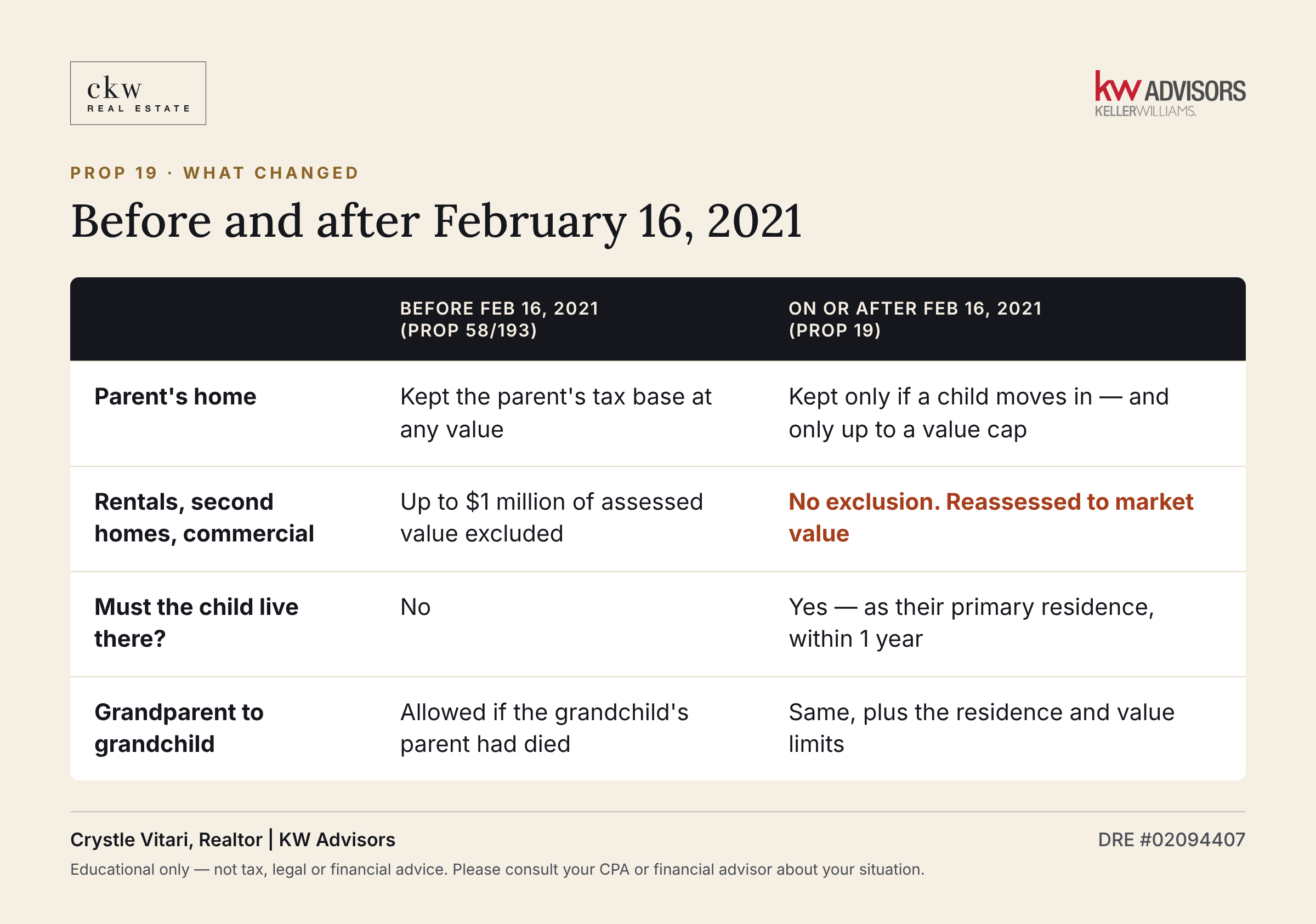
When a home is reassessed, the bill resets to today's market value. California's base levy alone is 1% of assessed value, plus San Francisco's voter-approved charges, so the annual bill can jump many times over.
Is Prop 19 being repealed?
A citizen initiative to restore the old rules has been gathering signatures. It is not among the measures certified for the November 3, 2026 ballot. Plan around the current rules.
How much of your parent's tax base can you keep?
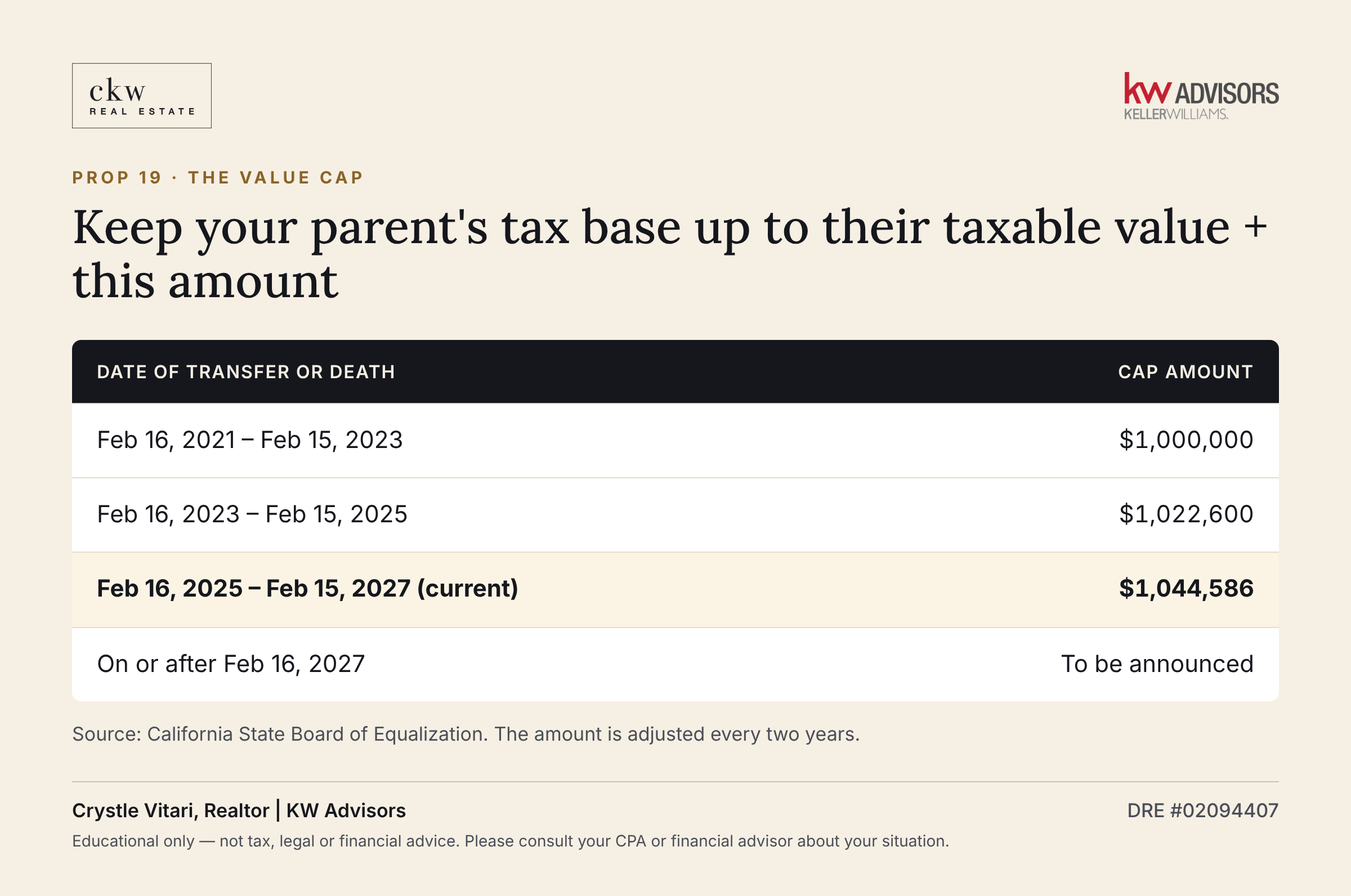
If you qualify, you keep your parent's tax base only up to this limit: your parent's taxable value + $1,044,586. Market value above that line is added to your new taxable value.
The $1,044,586 figure applies to transfers from February 16, 2025 through February 15, 2027. The State Board of Equalization adjusts it every two years.
Three San Francisco-style examples
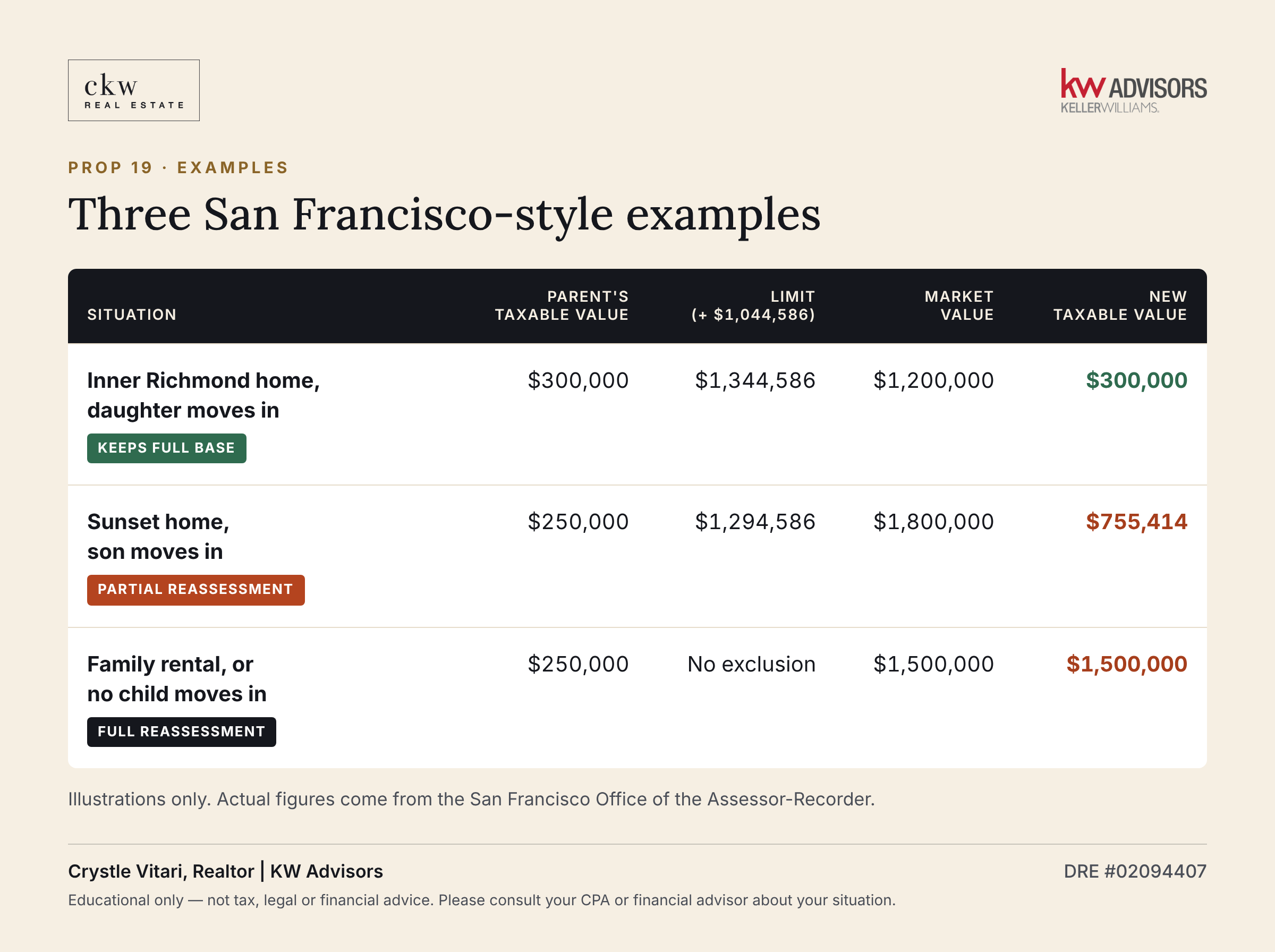
In the last example, the base levy alone goes from about $2,500 a year to about $15,000 — six times higher, before San Francisco's bonds and assessments.
These are illustrations. Your actual figures come from the San Francisco Office of the Assessor-Recorder.
Do you qualify to keep the tax base?
Check every box. Missing even one usually means full reassessment.
It was your parent's primary residence at the time of transfer or death (or a family farm).
It's a parent-to-child transfer, or grandparent-to-grandchild when the grandchild's parent has died.
You make it your primary residence within 1 year. The Assessor looks at where you vote, register your car, and actually live.
You file the homeowners' exemption within 1 year (Form BOE-266, or BOE-261-G for disabled veterans).
You file the exclusion claim (Form BOE-19-P, or BOE-19-G for grandchildren) within 3 years, or before selling to anyone outside the family, whichever comes first.
You keep living there. If you move out, the exclusion ends and the home is reassessed.
Common San Francisco situations
Two-unit and multi-unit buildings. Only the unit that was your parent's home and becomes yours is protected. The other units are reassessed at market value. An ADU may qualify with the main home.
A home held in a living trust. A trust alone does not avoid reassessment. At least one child must move in within a year, and both claims must be filed on time.
Several siblings inherit. One sibling can move in and claim the exclusion. Buyouts between siblings have their own rules, so talk to your estate attorney before anyone signs.
Holding title in an LLC. Not a workaround. If one person gains more than 50% control, the whole property can be reassessed.
The good news for parents: downsizing at 55+
The same law that tightened inheritance gave homeowners 55 and older a valuable new option: they can take their low tax base with them when they move.
Who qualifies: homeowners age 55 or older, severely disabled homeowners, and victims of a wildfire or natural disaster, when the home they're leaving had the homeowners' or disabled veterans' exemption.
How it works:
Move anywhere in California — any county
Buy or build the new home within 2 years of selling the old one
Owners 55+ can use it up to 3 times in a lifetime
File Form BOE-19-B (55+) or BOE-19-D (severely disabled) within 3 years of buying the new home

A family conversation worth having: if no child plans to live in the family home, selling while a parent is alive and moving their tax base to a smaller home can protect their taxes and avoid a full reassessment later. Weigh it with your CPA and estate attorney — capital gains and step-up in basis matter too.
San Francisco deadlines at a glance
The clock starts on the date of death, which counts as the date of transfer.
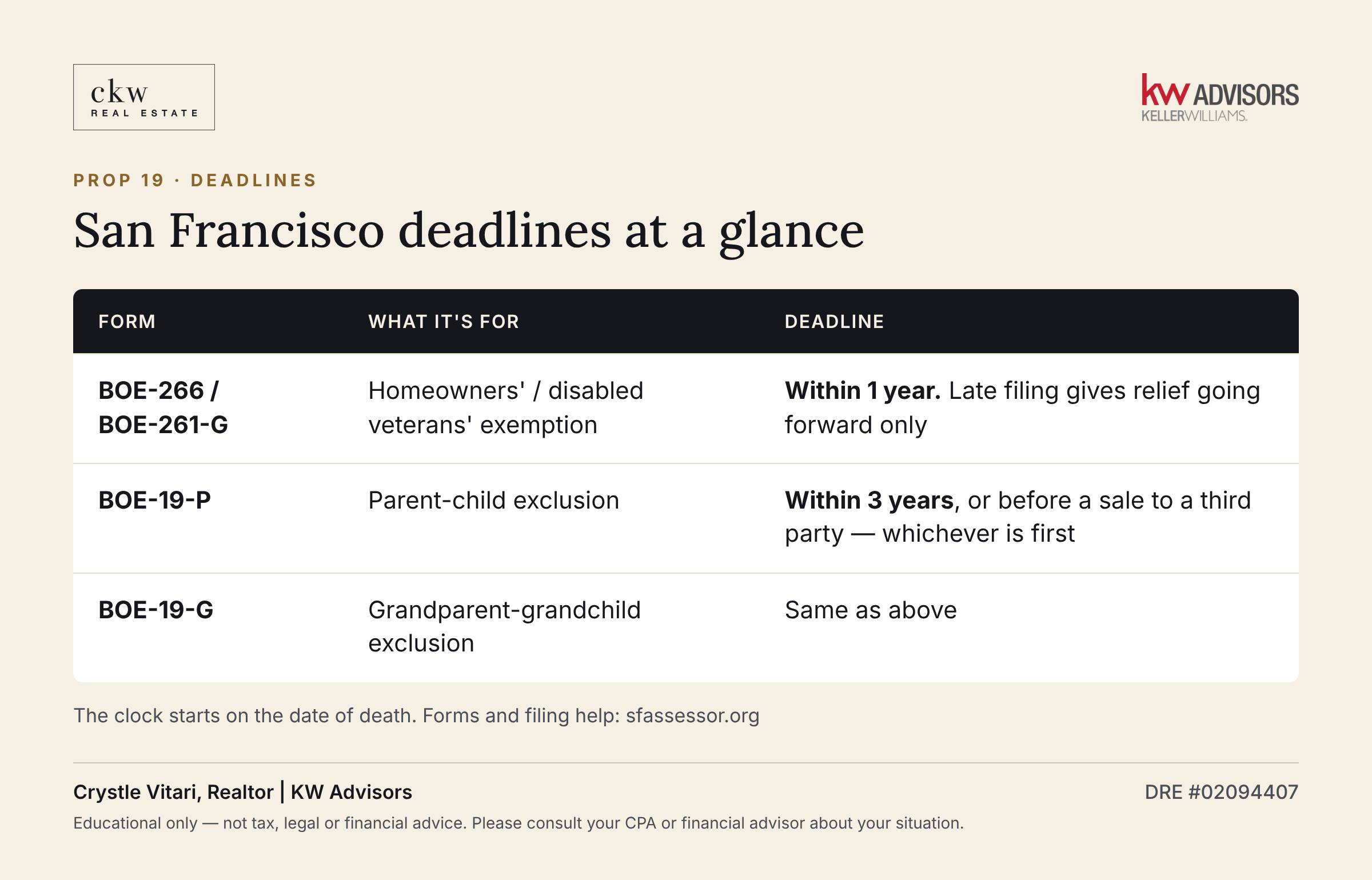
Forms and filing help: San Francisco Office of the Assessor-Recorder.
Your first-year checklist after a parent passes
First 30 days
Secure the home, insurance and utilities
Find the trust or will and contact the successor trustee or executor
Get your parent's taxable value from the SF Assessor-Recorder
Book an estate planning attorney and a CPA
Within 90 days
Decide as a family: move in, rent, or sell
Get a market value estimate to run the cap math
Ask your attorney about sibling buyouts
Within 1 year
If keeping it: move in as your primary residence
File the homeowners' exemption (BOE-266)
File the exclusion claim (BOE-19-P) — don't wait the full 3 years
Before you sell
File BOE-19-P first if you qualified; it must be filed before a sale to a third party
Plan the clean-out, repairs and staging
Confirm your tax basis with your CPA
Let's protect what your family built
With roots in San Francisco real estate going back three generations, I help families make clear, calm decisions about an inherited home: keep, rent, or sell, and how to prepare it so it sells well.
Request an Estate Equity Assessment: call or text 415-854-2224, or email crystle@ckwproperties.com.
Please note
I'm a Realtor — not a CPA, attorney or financial advisor. This article is general education, not tax, legal or financial advice. Please talk with your CPA, financial advisor or estate attorney before making any decisions about an inherited property. Rules and figures are current as of October 2026.
Compliance block (keep at the bottom of the post)
Crystle Vitari, Realtor | KW Advisors DRE #02094407 · Keller Williams Advisors DRE #01995149 · CKW Real Estate (DBA of In Jesus Name Bay Area Inc.) · Each office independently owned and operated